Video clip
►
Dr. Jacob TrevinoColumbia University Nano Initiative Labs
The next breakthroughs in quantum will not come from laboratories alone. They will come from connected ecosystems that bring together research, engineering, industry, capital, government, talent and end users.
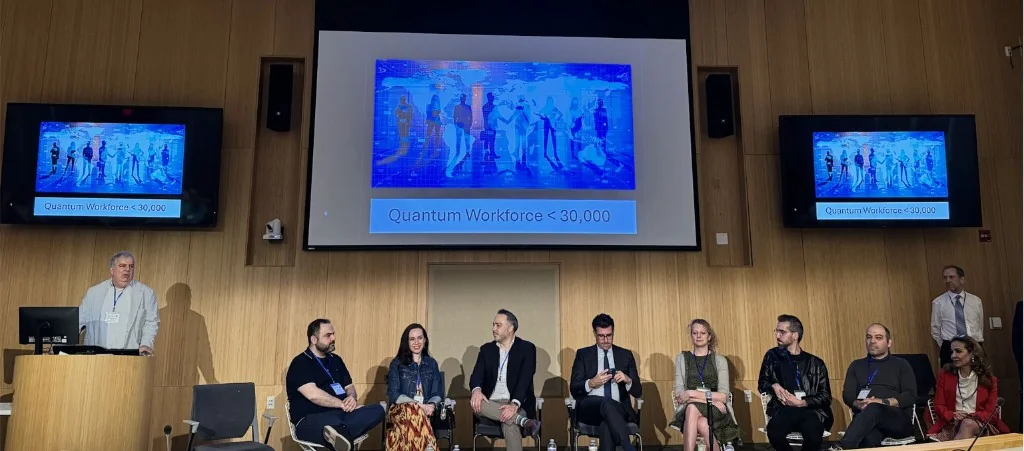
Today, fewer than 30,000 people work in quantum worldwide, and the demand for talent is accelerating faster than the pipeline built to supply it.1 McKinsey's Niko Mohr and coauthors find that there is only one qualified quantum candidate for every three open positions,2 and the Quantum Economic Development Consortium (QED) counted just 16,482 people employed at pure-play quantum companies in 2025 against 8,261 new quantum-related positions opened that same year.3 Boston Consulting Group (BCG) warns that access to quantum talent is already constrained and that organizations must begin developing quantum-aware leaders, quantum-literate operators and quantum-expert executors now.4 McKinsey's Niko Mohr and Henning Soller have also noted that even amid broader technology-sector layoffs, quantum talent remains scarce and highly sought after.5 Quantum Harlem exists to help prepare for that growth, starting in New York City, where an extraordinary concentration of research, industry, capital and talent creates the opportunity to build the workforce and ecosystem that the quantum economy will require.
The infrastructure is not only the laboratory. It is the ecosystem around it.
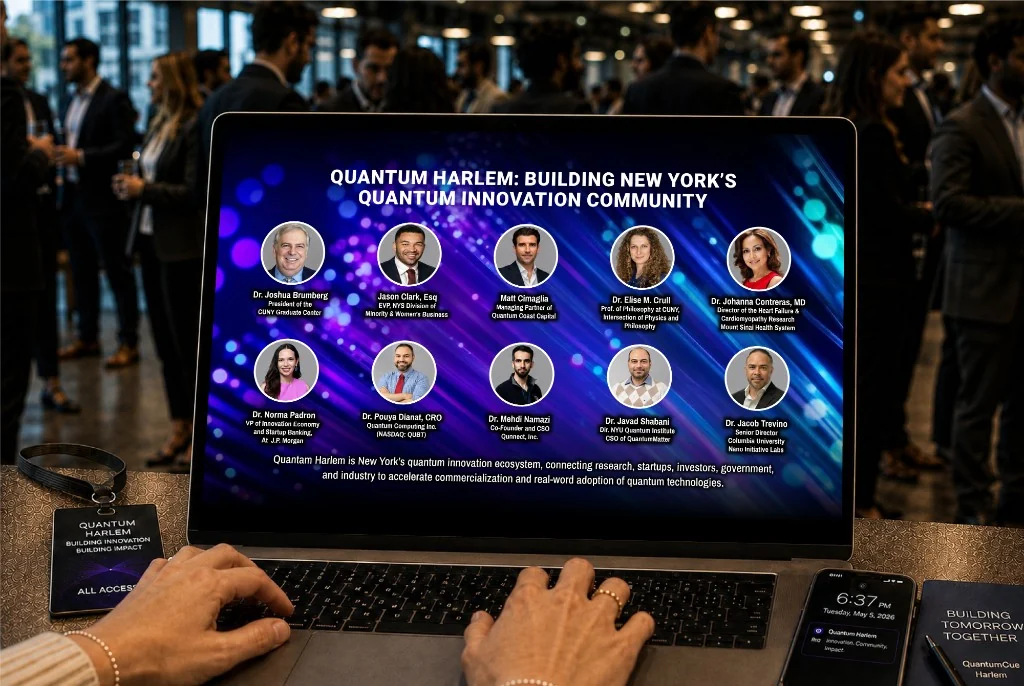 Dr. Joshua Brumberg on LinkedIn
Jason Clark, Esq. on LinkedIn
Matt Cimaglia on LinkedIn
Dr. Elise M. Crull on LinkedIn
Dr. Johanna Contreras, MD on LinkedIn
Dr. Norma Padron on LinkedIn
Dr. Pouya Dianat on LinkedIn
Dr. Mehdi Namazi on LinkedIn
Dr. Javad Shabani on LinkedIn
Dr. Jacob Trevino on LinkedIn
Tim Dutta on LinkedIn
Tavis Ezell on LinkedIn
Dr. German Kolmakov on LinkedIn
QuantumCue website
Dr. Joshua Brumberg on LinkedIn
Jason Clark, Esq. on LinkedIn
Matt Cimaglia on LinkedIn
Dr. Elise M. Crull on LinkedIn
Dr. Johanna Contreras, MD on LinkedIn
Dr. Norma Padron on LinkedIn
Dr. Pouya Dianat on LinkedIn
Dr. Mehdi Namazi on LinkedIn
Dr. Javad Shabani on LinkedIn
Dr. Jacob Trevino on LinkedIn
Tim Dutta on LinkedIn
Tavis Ezell on LinkedIn
Dr. German Kolmakov on LinkedIn
QuantumCue website
Quantum Harlem is a cross-sector platform, functioning as both a quantum innovation ecosystem and a quantum startup hub for New York City. It brings scientists, engineers, founders, investors, government, industry, educators and communities into one shared ecosystem, connecting every stage of the innovation lifecycle: research, engineering, commercialization, deployment and scale. It does this by convening people from different parts of that lifecycle in the same room, and by building the shared infrastructure, funding relationships, accelerator-style startup support and policy connections that let a technology keep moving instead of stalling where it started.
New York already has most of what a quantum economy needs, from research institutions producing genuine breakthroughs and engineering talent capable of building on them, to deep pools of venture and institutional capital and industries ready to adopt what works once it is proven. It has the density of a global capital, the depth of a research hub, and a state government already investing in the industries of the future. What has been missing is not any single piece, but a reliable way to move a technology, and the people behind it, from one part of that landscape to the next.
In practice, that gap shows up as friction, not absence. A researcher with a breakthrough result has no direct path to a foundry or a manufacturing partner. A founder with promising IP can't find patient capital or an enterprise customer willing to pilot early-stage hardware. An investor evaluating a deep-tech deal has no one in their network who can validate the underlying physics. A state agency directing workforce dollars doesn't know which lab, a few miles away, is closest to commercial relevance. None of this is a failure of capability. It is a failure of introduction.
Discovery → Engineering → Prototyping → Testing → Commercialization → Deployment → Scale
Each arrow in that sequence is a handoff, and each handoff is where a promising technology is most likely to stall. A discovery needs an engineer willing to take it out of the paper and into a working system. An engineering effort needs a prototyping partner with the right equipment and cleanroom access. A prototype needs a testing environment and an early customer patient enough to validate it. A validated technology needs capital and a commercialization partner who understands both the science and the market. A commercialized product needs a deployment partner willing to be first. And a deployed technology needs the infrastructure and talent to scale beyond a single use case. Quantum Harlem organizes that handoff sequence into four practical stages, Discover, Translate, Scale and Expand, so a technology can move from one stage to the next without losing momentum, creating stronger links between scientific discovery and real-world adoption.
Quantum Harlem builds those connections deliberately, through convenings, partnerships and collaborative projects.
A Quantum Harlem convening is built around a single working rule: the room includes as many parts of the ecosystem as possible, not just the labs. A single evening might put a physicist studying quantum coherence at the same table as a bank executive underwriting startup risk, a state economic development officer, and a founder months from a product launch. That mix is deliberate. The relationships that move a technology from a paper to a company rarely form inside one institution's walls, so the room itself has to be cross-sector before anything else can happen.
What began with the inaugural Quantum Harlem convening at CUNY ASRC is designed to grow into a broader New York ecosystem, strengthening the connections that move quantum technologies from discovery toward deployment and scale.
That growth includes a physical home. Quantum Harlem plans to establish a shared quantum lab facility, giving startups, researchers and industry partners access to specialized equipment, prototyping space and collaboration areas that few early-stage companies could justify building on their own. The goal is a quantum startup hub that complements the strengths of partner institutions across the ecosystem rather than duplicating them: a shared front door to New York's quantum infrastructure.
Quantum Harlem is also designed to work in coordination with New York's broader quantum hub network, not in isolation from it, sharing strategy and working toward common goals with other regional efforts advancing the state's quantum economy. From the outset, its impact on startups supported, research commercialized and jobs created is meant to be tracked and shared openly as the ecosystem grows.
Connect researchers, institutions and scientific leaders across disciplines to surface breakthroughs, capabilities and opportunities for collaboration.
Support quantum technology validation, prototyping and proof-of-concept development, building pathways that move scientific discoveries through engineering toward products, companies and real-world applications.
Connect innovators with patient capital, enterprise partners and government programs, through a startup accelerator and incubation program that helps quantum startups move from prototype to deployment.
Grow the human infrastructure around quantum through education, workforce pathways, entrepreneurship and broader participation in the industries being created.
Ecosystems grow through participation. Every new connection expands what the network can do.
Ecosystems compound in a way that no single institution can on its own. Each new participant, a lab willing to open its bench, a founder willing to test an early prototype, an investor willing to underwrite deep-tech risk, does not just add to the network. It creates new possible connections between everyone already in it, which is why participation, not size alone, is the right measure of an ecosystem's strength. Across the United States, a new model for quantum innovation is taking shape along that same logic. Research is increasingly being paired with specialized infrastructure, commercialization support, industry partnerships, capital and workforce development. Quantum Harlem brings that ecosystem approach to New York City by connecting the capabilities already here.












Quantum Harlem grew out of a gap that Tim Dutta and Dr. German Kolmakov experienced firsthand over seven years of working together. Tim, a multi-time startup founder, entrepreneur and investor who has launched and worked with mentoring top startup accelerators globally, taken patents from idea to product to market adoption, understood what happens after an idea shows promise: finding the right people, validating the market, raising capital, building partnerships and turning innovation into something customers will adopt. German, a professor of Quantum Physics at City University of New York (CUNY), a physicist, researcher and inventor, understood the other side: how scientific discoveries emerge, how research develops over years, and how difficult it can be to move highly technical innovation from the laboratory toward real-world commercialization.
Much of that seven-year collaboration centered on German's research and intellectual property, including their work exploring the potential of quantum interconnects and what it would actually take to move a complex scientific concept toward a commercially viable technology.
Working on quantum interconnects made that gap tangible: research and theory converging with productizing and commercialization.
What they repeatedly encountered was not a lack of talent, research or ideas. It was a lack of connection between the people who create breakthrough technologies and the people who know how to commercialize them. Universities and researchers collaborated within established laboratories and academic networks. Entrepreneurs, investors, corporations and experienced operators operated in different circles entirely. Bringing those groups together around a specific technology could be difficult, slow and highly dependent on individual relationships.
Commercialization requires more than a program. It requires an ecosystem capable of execution.
The original question was a narrow one: how to move a single promising technology from a lab bench toward a market. Answering it took years, and it worked only because Tim and German happened to bring complementary skill sets to the same problem. That experience raised an uncomfortable follow-on question. Most researchers do not have a commercialization-minded partner sitting across the table for seven years, and most entrepreneurs never meet the scientist whose work could become their next company. If advancing one technology required that much good fortune, the exception could not be the model. The experience led Tim to a much larger question.
If we are encountering these barriers while trying to commercialize one promising quantum technology, how many other discoveries across New York are facing the same problem?
That question helped shape the idea for Quantum Harlem. It was not conceived as another research laboratory or traditional quantum accelerator. It was conceived as connective infrastructure between communities that already possess different parts of what quantum commercialization requires.
Researchers create discoveries. Entrepreneurs understand how to turn those discoveries into companies and products. Industry provides real-world problems and pathways to adoption. Investors provide capital and commercial discipline. Government can catalyze research, infrastructure and economic development. Universities provide extraordinary scientific talent and intellectual property. The opportunity is to bring them together earlier and more effectively.
Seven years of trying to move one technology forward taught Tim and German the same lesson New York's broader quantum landscape now has to learn: the ingredients rarely need to be invented. What's missing is the introduction between them.
The direction is unmistakable: quantum is moving from breakthrough science toward infrastructure, commercialization and deployment. The institutions leading that transition are investing in the ecosystems required to scale it.
“America stands at the cusp of a quantum revolution.”
Executive Order 14413 directed a whole-of-government effort spanning quantum computing, sensing and networking, with emphasis on research, manufacturing, commercialization, workforce and deployment.
View source ↗$1.5B
NSF launched X-Labs as a new model for milestone-driven breakthrough science, bringing researchers, engineers and entrepreneurs together across traditional institutional boundaries.
View source ↗$2B+
More than $2 billion in planned federal incentives is aimed at accelerating quantum computing, domestic manufacturing, foundries and technologies required for utility-scale systems.
View source ↗“America led the last computing revolution, and we intend to lead the quantum age as well.”
DOE's Quantum Genesis initiative aims to develop and deploy scientifically relevant, fault-tolerant quantum computing, linking quantum advancement to national-scale scientific infrastructure.
View source ↗“No single approach can deliver everything needed for large-scale, high-performance quantum systems.”
DARPA's HARQ program is advancing architectures that connect different quantum technologies through high-fidelity interconnects.
View source ↗“By the end of the 2030s, we are now pretty convinced this is a trillion dollars of value.”
IBM plans to invest more than $10 billion in quantum computing over the next five years, spanning R&D, manufacturing and ecosystem expansion.
View source ↗“IonQ's quantum-secure communications and advanced networking capabilities strengthen innovation ecosystems.”
IonQ is extending quantum networking beyond individual systems into research, infrastructure and regional innovation networks.
View source ↗“Quantum computing has the potential to unlock new possibilities across science, industry and national priorities.”
Quantinuum is scaling fault-tolerant quantum systems while expanding partnerships across manufacturing, engineering and commercial applications.
View source ↗“We are not just scaling our footprint; we are accelerating the pace of innovation.”
Xanadu is expanding around closer collaboration with strategic partners while advancing photonic quantum computing toward practical, scalable systems.
View source ↗“Supercomputers will be quantum-GPU systems, combining the ability to simulate nature with GPU-scale parallelism.”
NVIDIA is positioning quantum alongside AI and supercomputing, connecting academia, laboratories, startups and industry through hybrid infrastructure.
View source ↗“This facility will be critical infrastructure, strengthening Australia’s sovereign capability.”
PsiQuantum's strategy combines photonics, semiconductor manufacturing, networking, cryogenics and government partnerships to build quantum systems at infrastructure scale.
View source ↗“Quantum computing has reached a commercial tipping point.”
More than 300 organizations are now engaging with quantum computing as activity moves from research collaborations toward applications, workflows and enterprise adoption.
View source ↗Different architectures. Different institutions. One direction: quantum is becoming an ecosystem-scale industry.
The next advantage will come not only from who builds the best technology, but from who builds the strongest system around it.
Quantum Harlem is being built for that next phase.
As more voices join, this becomes a living record of how researchers, founders, investors, policymakers and end users see the path from quantum research to real-world impact.
A cross-sector panel does not run itself. Quantum Harlem’s inaugural convening was moderated by three people who each sit at a different point in the ecosystem the evening was trying to connect.
Special thanks to Yuki Chen and The ASRC Sensor CAT Team.
Independent press coverage and firsthand reflections from people in the room are already describing what Quantum Harlem set out to prove: that quantum is becoming a connected, commercial and institutional ecosystem, not just a research discipline.
“One number framed the whole evening for me. Tim Dutta of QuantumCue noted that the global quantum workforce is still under 30,000 people. That is not a sign that the industry is small. It is a sign that the people building it still know each other by name, that the network effects of the field are concentrated, and that the firms moving now are doing so before the curve steepens.”
Independent coverage from The Quantum Insider: Matthew Cimaglia’s post-event article captured the larger theme of the evening, quantum becoming not only a scientific discipline, but an increasingly connected commercial and institutional ecosystem.
Read the article ↗“It was a fun participating at the Quantum Harlem panel at The City University of New York discussing the #quantum business and what we are doing to commercialize the technology at Quantum Computing Inc. Great to catch up with friends and colleagues Javad Shabani, Norma A. Padrón, Ph.D., Jacob Trevino, and Mehdi Namazi. Special thanks to Tim Dutta and German Kolmakov.”
Post-event reflection on commercialization, colleagues and the New York quantum community.
These excerpts are curated event reflections, not embedded social-media screenshots, presented this way to keep the page visually consistent while preserving each speaker's voice and clear attribution.
New York brings together an unusual concentration of research universities, advanced scientific facilities, quantum companies, financial institutions, investors, global enterprises, healthcare systems and public-sector resources within a remarkably compact geography.
That density is unusually literal. A researcher running experiments at CUNY ASRC in Harlem is a single subway ride from investment banks in Midtown, from Columbia’s engineering labs uptown, and from NYU’s physics department downtown. A founder can meet a state economic development officer in the morning and an enterprise buyer in the afternoon without leaving the five boroughs. Most regions spend decades trying to build that kind of proximity. New York already has it. It has simply never been organized around quantum specifically.
Harlem is a natural nexus for that work, positioned among major research institutions and connected to the scientific, commercial and financial infrastructure of the broader New York region.
Harlem sits at the intersection of world-class research, education, healthcare, entrepreneurship and community. Quantum Harlem starts here, but its ambition is citywide: to create stronger connections across New York while making the emerging quantum economy more accessible to the people and communities who will ultimately help build it.
Harlem has been the seat of ambitious, world-changing work before. It anchored a cultural and intellectual movement that reshaped American arts, ideas and identity in the twentieth century, and it remains home to one of the country's most diverse populations and a deep base of educational and civic institutions. Building a quantum ecosystem here is not an arbitrary choice of geography. It is a bet that the same neighborhood that has produced generations of scientists, artists, entrepreneurs and civic leaders is exactly where a more accessible version of the quantum economy should begin.
Harlem is the starting point. New York is where it connects.
You do not need a PhD in quantum physics to have a role in what comes next. Building the quantum economy will require scientists and engineers, but it will also require entrepreneurs, investors, software developers, manufacturers, educators, policymakers, healthcare leaders, students, designers, operators and people with ideas we have not yet imagined. Quantum Harlem is built on the belief that the economic upside of this industry should reach the neighborhood it starts in, not just the institutions inside it.
That means building pathways into the quantum workforce for students and residents who are not yet on a traditional STEM track, alongside the researchers and engineers already deep in the field. Harlem's base of public education, community colleges and civic institutions is exactly the kind of infrastructure a workforce pipeline needs. The opportunity is to connect that infrastructure to the quantum economy the same way Quantum Harlem connects labs to capital and startups to industry.
Bring quantum out of the lab and into public view through convenings, talks and programming open to students, educators and residents with no technical background required.
Connect New York's schools, CUNY, Columbia University, NYU campuses and all other New York State institutions and community colleges to quantum curricula, mentorship and hands-on exposure to the field.
Create structured, paid entry points into the ecosystem's labs, startups and partner institutions for students and early-career residents.
Build routes from those entry points into durable jobs across research, engineering, operations, policy and the many non-technical roles the quantum economy will need.
The people building the quantum economy should look like the neighborhood it starts in.
Quantum Harlem is designed to operate as an ongoing platform rather than a single convening. The inaugural gathering at CUNY ASRC was a starting point, not the program itself. The model is a repeatable cycle: convene the ecosystem, move researchers and startups through the Discover → Translate → Scale → Expand pathway, measure the outcomes, and convene again, so the network keeps compounding rather than resetting after each event.
The value of an ecosystem comes from its cadence, not any single event.
That reliability depends on a funding base that does not rest on any single source. Quantum Harlem's long-term sustainability is built around a diversified model: renewed state and public funding, corporate sponsorships and ecosystem membership, philanthropic and foundation support, and earned revenue from the shared quantum lab facility and startup incubation program once they are established. Spreading support across public, private and earned sources is what allows the ecosystem to keep running independent of any one grant cycle.
Quantum Harlem is anchored by permanent institutions rather than a single grant-funded initiative, and it is built around the reporting and performance measurement that let funders and partners see, and renew their confidence in, what the ecosystem is producing over time. The goal is a cadence of convenings and a pipeline of startups that partners can plan around year over year.
For the first time, researchers, founders, investors, industry leaders, government, institutions and communities are being brought together around a shared effort to build New York’s quantum ecosystem.
Quantum Harlem is creating the connections that rarely happen on their own. Between science and industry. Between laboratories and startups. Between capital and emerging technology. Between public resources and the people building what comes next.
Quantum Harlem is open to everyone who can contribute to that future. Whether you are researching quantum, building technology, funding companies, developing applications, educating the next generation, creating policy, providing infrastructure or simply beginning to explore where you might fit, there is a place for you in this ecosystem.
The opportunity is not simply to participate in the quantum economy. It is to help shape how New York builds it.
Research it. Build it. Fund it. Apply it. Teach it. Join it.
Tell us a bit about yourself and we'll be in touch.
Thank you for contacting Quantum Harlem.